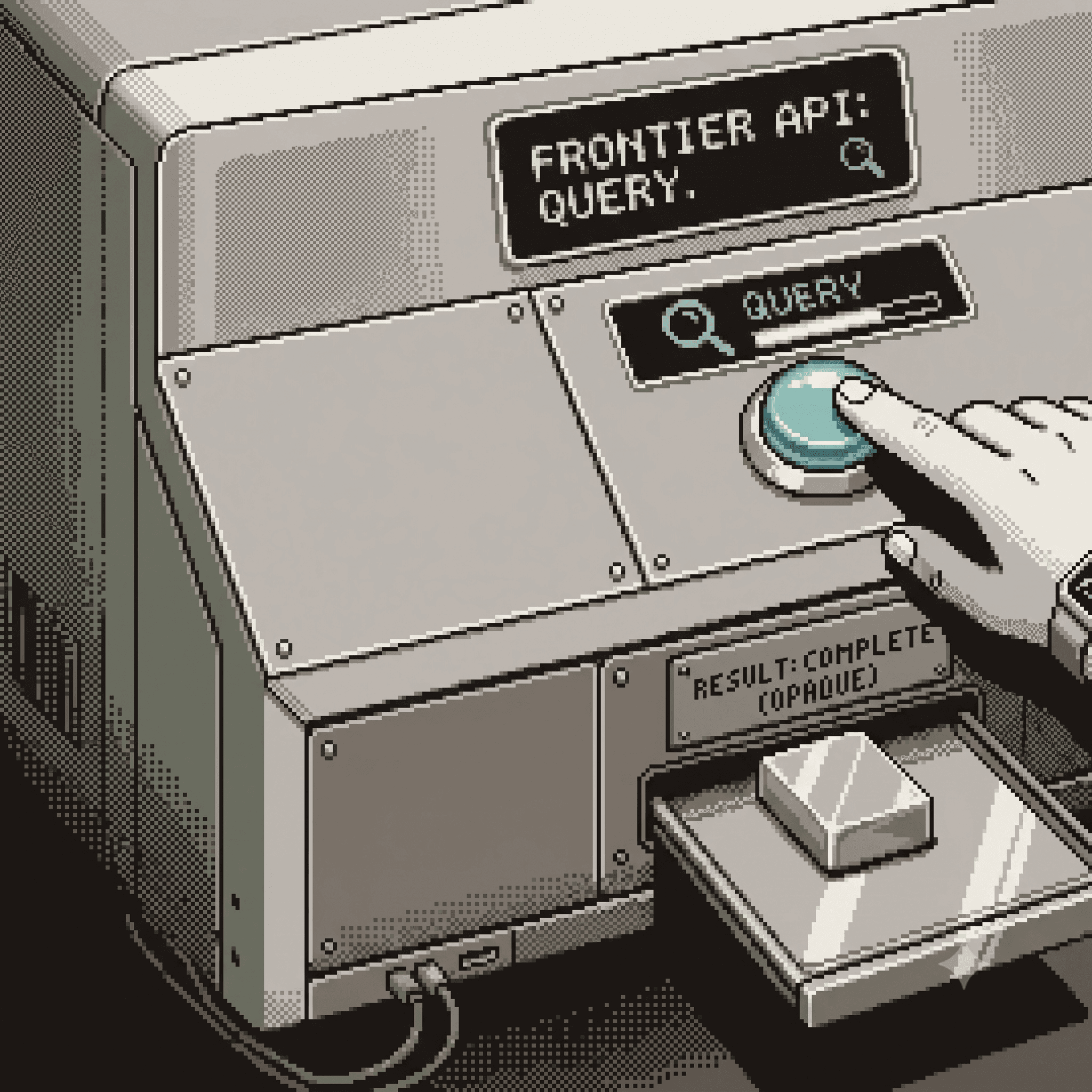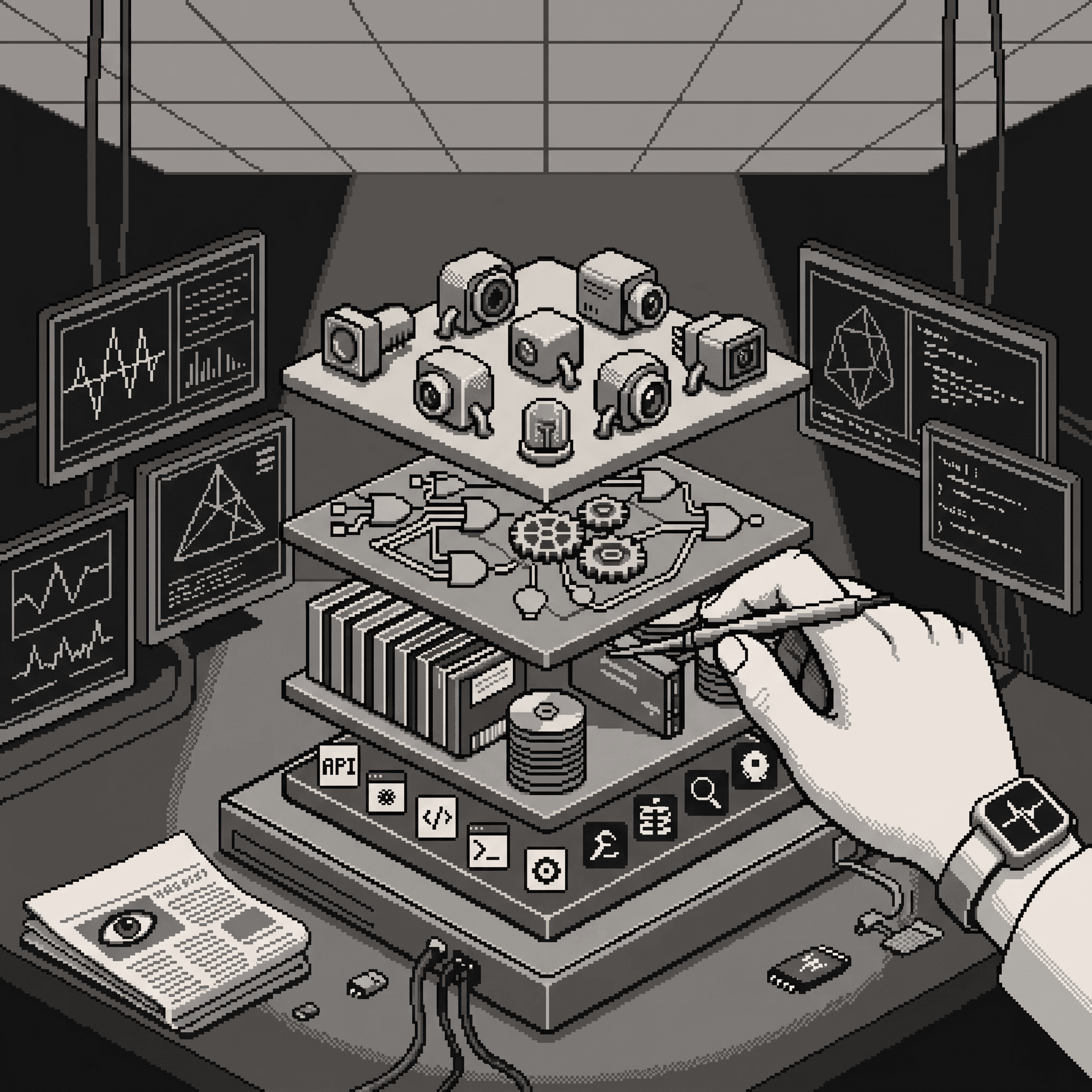

Application layer companies are training their own models. Why?
Application layer companies, often labelled as 'ChatGPT wrappers', are starting to train their own models. Specialist models, post-trained or fine-tuned on a dataset their competitors cannot touch: their own production traffic.
Four recent examples:
- Cursor trained Composer, the model inside its coding agent, with online RL on production agent traces. Delivering frontier-level coding at a fraction of the latency and cost.
- Intercom trained Fin Apex, a customer-service model post-trained on billions of support interactions. It bought them control of the resolution-rate metric at scale.
- Replit trained a 7B code-repair model, a fine-tune of DeepSeek-Coder-Instruct-v1.5. It bought them a fast, narrow specialist trained on IDE data nobody else has.
- Perplexity trained Sonar, its search-answer model, a fine-tune of Llama 3.3 70B served on Cerebras hardware. It bought them sub-second, citation-heavy answers at search scale.
Cursor: reinforcement learning on live agent traces
Cursor didn't fine-tune once and ship. The Composer family of models run on real-time RL: model checkpoints go to production, real user interactions become the reward signal, and an improved checkpoint ships several times a day. The model is a mixture-of-experts architecture trained inside a harness built to mirror Cursor's actual tool space, including file edits, semantic search, and terminal commands. The reward signal reflects how developers really use the product rather than a synthetic benchmark, according to Cursor's technical post on Composer.
Cursor reports Composer generates tokens several times faster than comparable frontier models while landing close to the top tier on internal coding benchmarks, a tradeoff explored in more depth by the Composer 2 technical report. Nobody else has Cursor's trace data, which means nobody else can train Cursor's model, even with an identical base checkpoint and an identical training recipe.
What it bought them: coding performance competitive with larger models, at preferential latency and cost, plus a moat provided by their own proprietary data.
Intercom: post-training on the metric the product is sold on
Fin launched in 2023 on top of GPT-4. Fin 2 moved to Claude in late 2024. Then Intercom's roughly 60-person AI research group, led by Fergal Reid, built Fin Apex 1.0, a model post-trained on the company's own support interaction data, as described in the Fin Apex launch post.
One large enterprise customer saw its resolution rate jump from 68% to 75% overnight after the switch to Apex, a 22% cut in unresolved conversations according to Intercom's own numbers. Independent coverage from VentureBeat puts Apex's benchmark resolution rate at 73.1%, against 71.1% for both GPT-5.4 and Claude Opus 4.5. Intercom's own model documentation breaks the pipeline into separate retrieval, reranking, and generation models rather than one monolithic system, detailed on the Fin CX models page.
Worth noting: Intercom hasn't abandoned rented models. Apex is layered on top of retrieval and routing components, and the company still uses third-party models elsewhere. This architecture is common as companies balance performance, latency and cost.
Replit: a narrow 7B specialist trained on IDE telemetry
Replit's bet was the opposite of "bigger is better." The team fine-tuned a 7B open-weights model, DeepSeek-Coder-Instruct-v1.5, chosen after testing several code-focused base models and documented in its code-repair write-up.
The model targets a specific use case, roughly the 20 diagnostic categories responsible for the majority of everyday coding errors, and the fine-tuned 7B checkpoint matched or beat GPT-4 and Claude 3 on real-world fixes in that use case. Small open source models can beat much larger general-purpose models at many tasks.
Perplexity: search-optimised inference at 1,200 tokens per second
Perplexity fine-tuned Meta's Llama 3.3 70B into Sonar, tuned specifically for factual grounding, citation quality, and readability in its default search mode, as the company explains in its Sonar launch post. Sonar runs on Cerebras wafer-scale inference hardware, which Perplexity and Cerebras jointly announced pushes throughput to roughly 1,200 tokens per second, an order of magnitude faster than comparable models on conventional GPU inference.
In Perplexity's own A/B testing, Sonar matched or beat larger frontier models on user satisfaction inside search, while running far cheaper and faster than calling those models directly.
Why build a specialist model instead of prompting a frontier one?
Calling a frontier model for every request is sometimes the equivalent of running a data centre to toast bread. It works, but it's the wrong tool for a narrow, high-volume, well-defined job. Across these four companies, three conditions kept showing up:
- A narrow task, not a general one. Small specialised models are excellent at one narrow task. Don't ask them to be broadly intelligent.
- Proprietary production data no competitor can access. Cursor has Cursor's traces. Intercom has Intercom's support conversations. Your production traffic is the one dataset nobody can buy.
- Enough volume that per-token latency and cost actually move the P&L. Fine-tuning a model can be expensive. It only pays off once inference volume is high enough that shaving cost per call compounds.
None of these companies want to out-build OpenAI or Anthropic on general intelligence. Each trained a model that wins one specific task, using the one dataset it uniquely owned.
Capture production traces, turn them into a labelled dataset, train a model on it, and ship that model back into production. That's where the application layer is going.
Overmind is the model training platform for AI teams. It turns your production traces into specialised models you own. Get started.