Model training
Own your model
Fine-tune a model on your own data, measure it with your own evaluators, and serve it through an OpenAI-compatible endpoint. Keep the training data, benchmark and deployment connected from the first experiment to production.

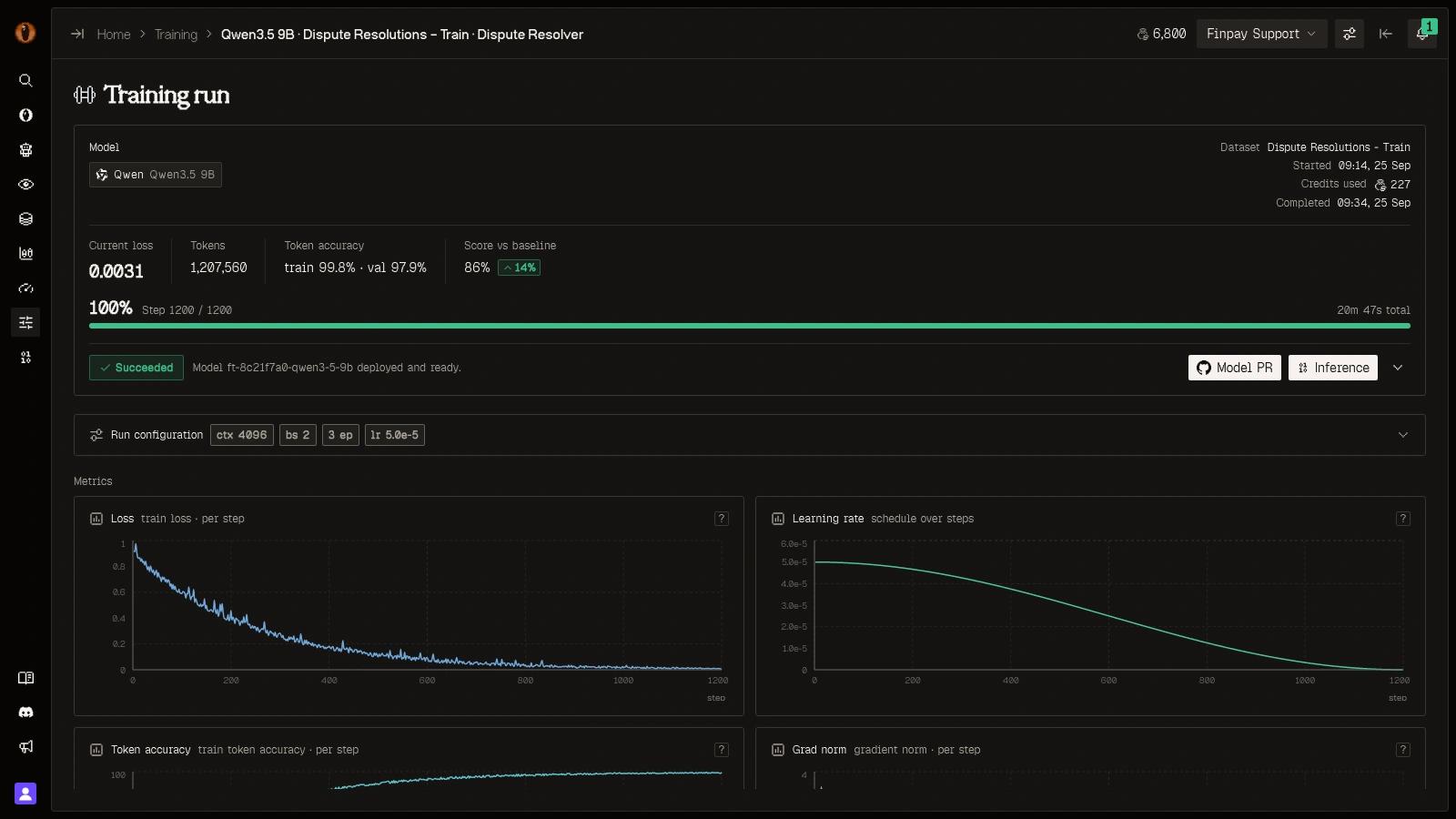
From dataset to a model you can deploy
Choose the experiment, inspect the evidence, and decide when the model is ready for traffic.

Configure from the data you have
Choose training, validation and evaluation data, then inspect model recommendations, compatibility, cost and duration estimates. Launch multiple experiments with different base models or hyperparameters. Use LoRA adapters or full fine-tuning where the selected model supports them.
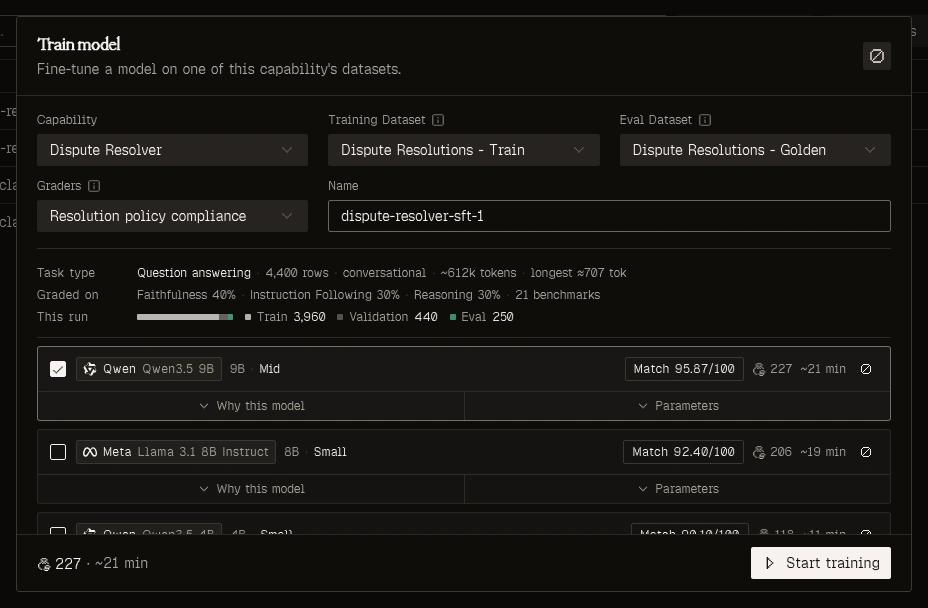

Follow every stage of the run
Track preparation, training and deployment in one place. Inspect train and validation loss, learning rate, token accuracy and gradient norm alongside steps, tokens and credits. Each experiment keeps its configuration and data version linked to the resulting model.

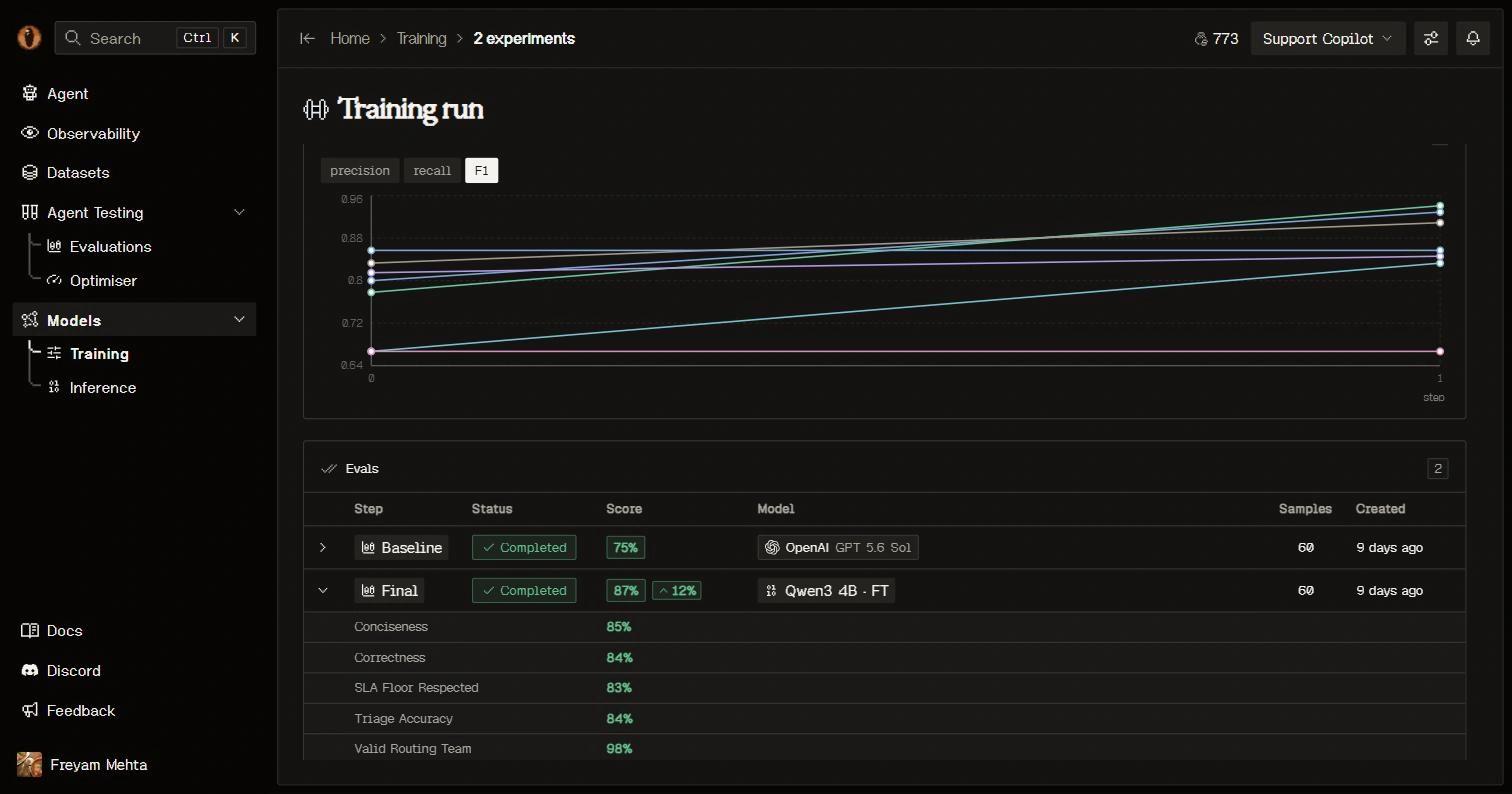
Choose what you benchmark against
Select the codebase incumbent or a ready trained model as the benchmark, independently of live serving. Choose which before-and-after evaluations to run. Comparisons use pinned eval data, prompt snapshots and graders; inspect per-metric deltas and sample results before making a deployment live.

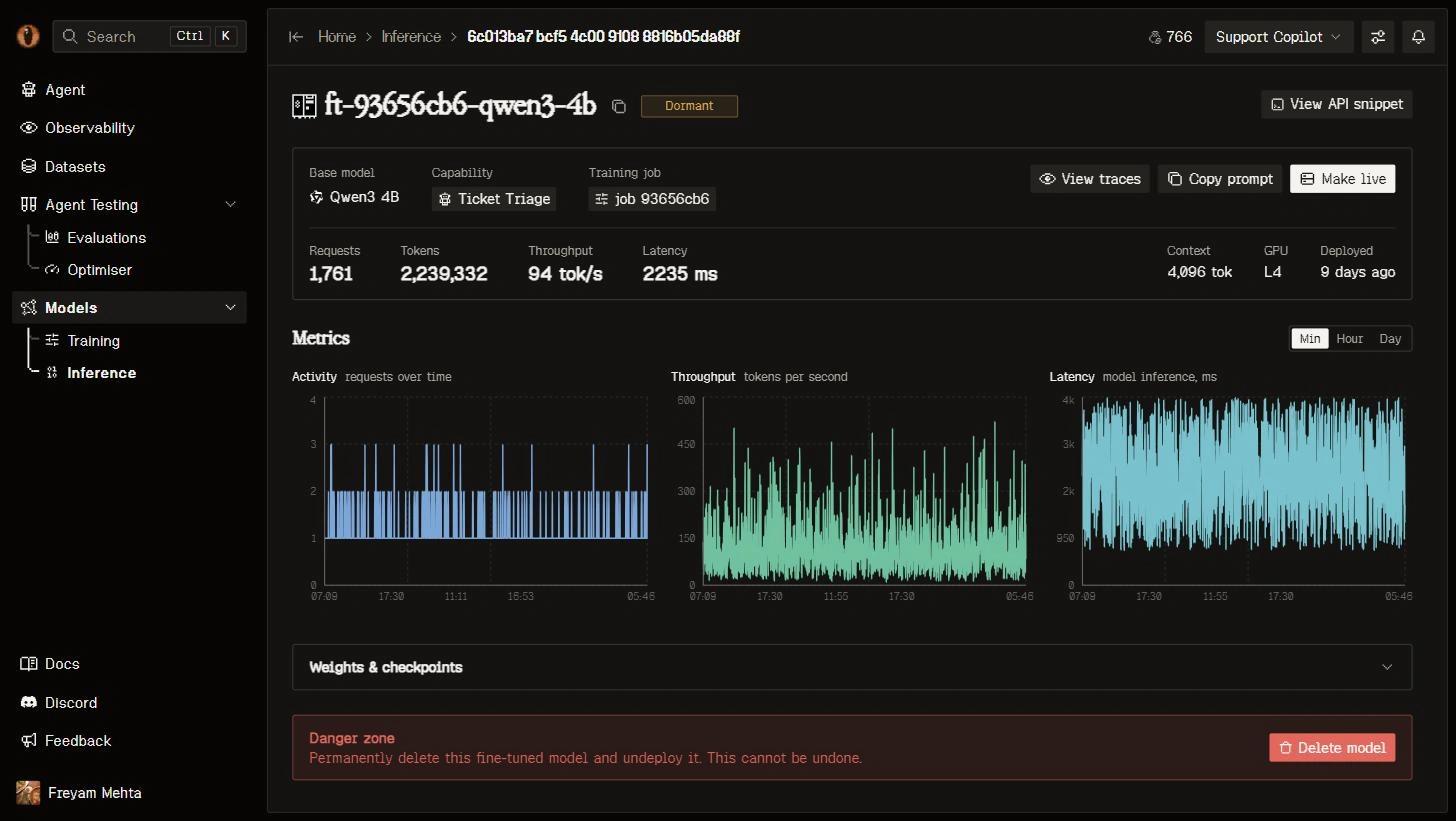
Serve it. Switch it. Keep the weights.
Successful training deploys a model to hosted inference. Call it from an OpenAI-compatible client, or route a capability alias to a ready deployment. Copy a coding-agent prompt to update your repository, test the endpoint, and download the checkpoint when you want the weights.
What you get
Training
Dataset-aware setup
Use row shape, token lengths and tool-calling requirements to choose a compatible model and configuration.

Multiple experiments
Compare base models and hyperparameters while keeping training and evaluation inputs explicit.
Validation controls
Choose a validation dataset or split and inspect loss, accuracy and other run metrics.
Benchmarking
Independent benchmark
Choose the comparison target without changing the model serving live traffic.

Before-and-after evaluation
Select the benchmark and training-model evaluations to run, with the same pinned data and graders.

Classification metrics
For labeled classification tasks, inspect precision, recall, F1 and confusion matrices alongside overall scores.
Serving and ownership

OpenAI-compatible inference
Use standard chat completions and model endpoints for your hosted fine-tunes.

Controlled rollout
Switch a capability alias to a ready model or use a coding-agent prompt to make a repository change.

Downloadable checkpoints
Keep access to the trained weights, with the model linked to its source job and dataset.
Your data. Your model.
Train, evaluate and serve specialized models from the same platform.